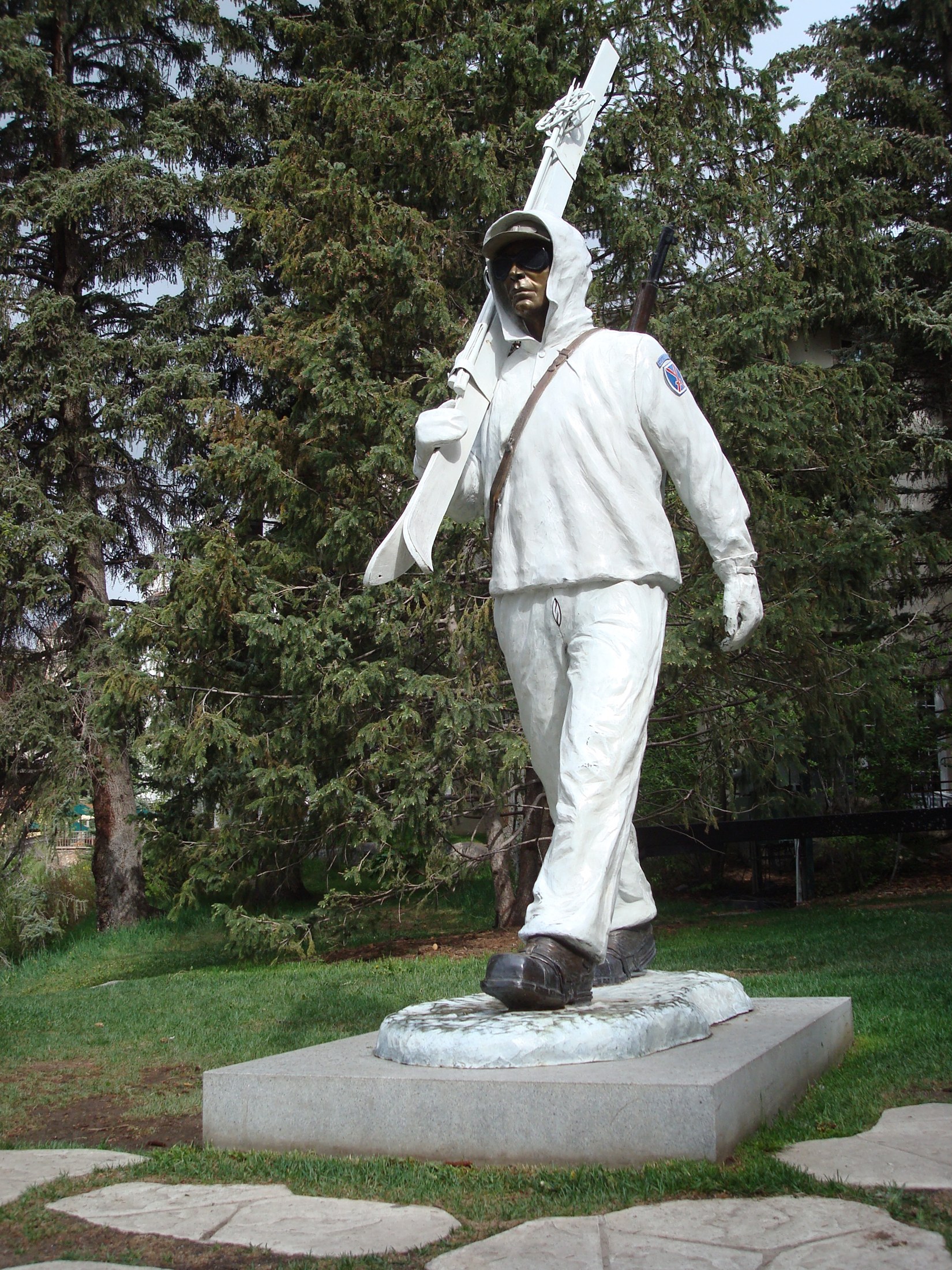
Most mornings I pass a bronze soldier on skis, 12 and a half feet tall, standing watch in Slifer Plaza near the covered bridge. Visitors photograph it without always knowing what it is. To me, it's one of the most important landmarks in Vail Village, because without the men it honors, there would be no Vail at all.
The men the statue honors
The sculpture is a memorial to the 10th Mountain Division, the U.S. Army's specialized mountain and winter-warfare unit of World War II. Roughly 18,000 soldiers trained for it at Camp Hale, a high, brutally cold outpost tucked into the mountains just south of our valley. They learned to ski, climb, and survive at altitude under heavy packs, then carried those skills into some of the hardest alpine fighting of the war, including the assault on Riva Ridge in the Italian Apennines. The 12-and-a-half-foot, roughly 7,000-pound bronze was dedicated in 1997, from a concept by artist Scott Stearman and cast by sculptor Victor Issa. Vail skier and filmmaker Chris Anthony chronicles the division's story in his documentary Mission Mt. Mangart, about the first American ski troops.
From a training camp to a ski town
One of those Camp Hale soldiers was a young trooper named Pete Seibert, who was badly wounded in Italy and told he might never ski again. He came back to Colorado anyway. In 1957 he and a local prospector named Earl Eaton hiked to the top of the mountain the two of them had their eye on, looked out over the back bowls, and decided to build the most beautiful ski resort in the world. Five years later, on December 15, 1962, Vail opened with two chairlifts, a gondola, and five-dollar lift tickets.
Why that history still shapes the valley
You can feel the 10th Mountain Division in the character of this place. The comfort with hard winters, the respect for the mountains, the belief that a life built around skiing and the outdoors is a serious and worthy thing: that all traces back to Camp Hale. Many of those veterans stayed in Colorado and started the ski schools, the shops, and the towns that grew into the industry we live in today. Vail wasn't dreamed up by a developer looking at a map. It was built by soldiers who had already fallen in love with these mountains the hard way.
You can still visit where it started
Camp Hale itself is only about a half-hour drive south, and in 2022 it was designated the Camp Hale-Continental Divide National Monument. The barracks are long gone, but the concrete foundations, the interpretive signs, and the enormous quiet of that high valley are still there. It's one of my favorite places to send clients who want to understand where all of this came from. And you don't even have to leave the village to go deeper: just a few hundred feet from the statue, the free Colorado Snowsports Museum tells the fuller story of the 10th Mountain Division and the people who turned it into a ski town.
A sense of place you can't manufacture
People ask me what makes the Vail Valley different from every other resort town, and the honest answer is the story underneath it. This isn't a manufactured destination. It grew out of real history, real sacrifice, and a genuine love of these mountains, and you can still feel that in the neighborhoods, the trails, and yes, the bronze soldier keeping watch in the village. If you're thinking about putting down roots here, I'd be glad to show you around, statue included.
Learn more: The Colorado Snowsports Museum in Vail: the 10th Mountain Division & the founding of Vail
Frequently Asked Questions
Where is the 10th Mountain Division memorial in Vail?
It stands in Slifer Plaza in Vail Village, near the covered bridge over Gore Creek. The 12-and-a-half-foot bronze ski soldier is one of the most photographed landmarks in the village.
What was the 10th Mountain Division?
It was the U.S. Army's specialized mountain and winter-warfare unit in World War II. About 18,000 soldiers trained for it at Camp Hale, just south of Vail, before fighting in the Italian Alps.
Where is Camp Hale?
Camp Hale sits about 30 minutes south of Vail near Tennessee Pass and Red Cliff. It was designated the Camp Hale-Continental Divide National Monument in 2022 and is open to visitors.
How did the 10th Mountain Division lead to the founding of Vail?
Pete Seibert trained as a ski trooper at Camp Hale and was wounded in Italy. He returned to Colorado after the war and, with local prospector Earl Eaton, opened Vail as a ski resort in 1962.
When was the Vail soldier statue dedicated?
The memorial was dedicated in 1997. It was created from a concept by artist Scott Stearman and cast by sculptor Victor Issa, and weighs roughly 7,000 pounds.